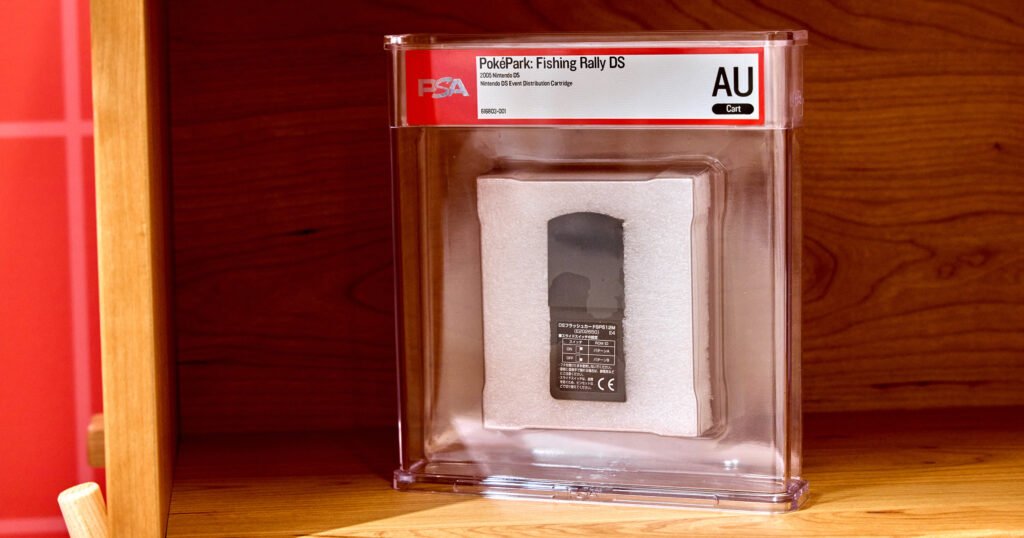
A playable copy of PokéPark: Fishing Rally DS has resurfaced, been authenticated, and been sealed in a collector’s case. Protecting that cartridge matters. Preserving the game as something people can play requires keeping its software usable, too.
PSA’s November 13 account confirms that it authenticated and encapsulated the cartridge. Claire Shelton, who heads its video-game division, says she played the game for roughly two hours in September before its submission.
Dexerto’s report quotes @KirbyCheatFurby asking for the case to be opened and the software copied. That request gets at the gap between a recovered collectible and a game people can actually access.
The Original Game Was Supposed to Disappear
This was a fishing minigame distributed at PokéPark, the temporary Pokémon attraction held in Japan in 2005. PSA also identifies a Taiwan event in 2006. A contemporary May 2005 report described visitors downloading it to their own DS systems and competing through their catches. Switching off the handheld erased the downloaded game.
That makes the surviving cartridge particularly interesting. The ordinary visitor’s copy was temporary, making the hardware capable of distributing it an important part of keeping the experience available.
In IGN’s original report, collector Daniel Quadri provided photos and videos showing the game running and transmitting to another DS through Download Play. That function echoes the attraction’s distribution: giving another person a chance to play on their own handheld.
A Protected Object and an Accessible Game
PSA’s account emphasizes authentication and the confidence it gives a future collector buying the item. Shelton also describes a separate high-score transfer cartridge submitted by another owner, distinguishing it from the playable game.
A game’s history also includes its behavior: how catching worked, what changed between fishing spots, and how its scoring encouraged people to play. Keeping the software usable lets people study those decisions. A photograph of a cartridge’s label cannot supply that experience.
A publicly accessible playable version, accompanied by documentation of how it runs, would let this discovery reach beyond collectors and their visitors. It would give people who missed PokéPark the chance to encounter its game as players, rather than having to imagine it from the outside of a case.
Official artwork: PSA.